
On this page:
Humayun’s Tomb
The first garden tomb on the Indian subcontinent, sitting in Nizamuddin East. Humayun's widow commissioned it, and it was finished in 1572 — seven years in the making — a full sixty-odd years before a later Mughal would borrow the same idea and build the Taj Mahal. UNESCO named it a World Heritage Site in 1993.
But the dates aren’t the reason you’ll choose to go.
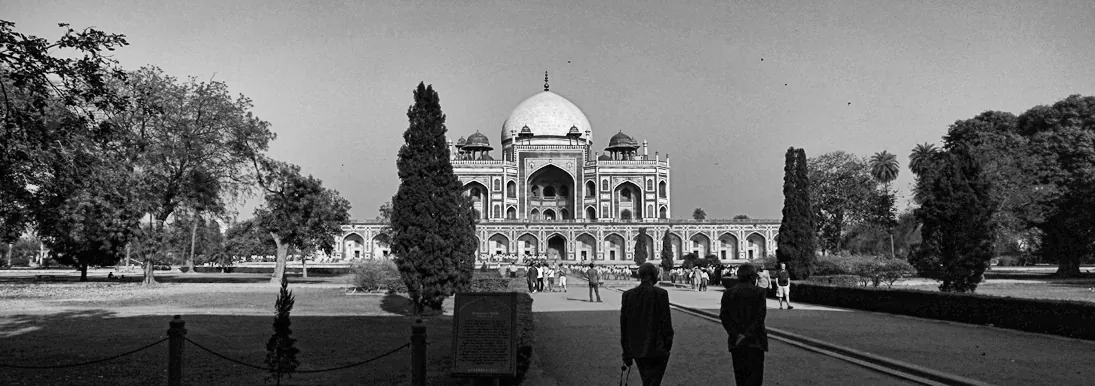
Humayun’s Tomb rewards two completely different kinds of visitor. Bring a camera and you'll lose an hour to the symmetry alone — the dome floating above its plinth, the jaali screens throwing lattice-shadows across the floor, the long water channels splitting the gardens into perfect quarters. Bring no agenda at all and the place does something rarer: it goes quiet. The traffic of the city you fought through to get here simply stops at the gate. The lawns are deep and shaded, the promenades unhurried. It's one of the few spots in Delhi where you can hear yourself think.
Tickets are sold at the official booth on the boundary wall (around Rs. 600 — verify current rate, and note foreign-national tickets are priced higher). Pro-tip: Humayun's Tomb and Sunder Nursery sit shoulder to shoulder, so the combo ticket (around Rs. 950) gets you the heritage park next door too — its own museum, and a cluster of cafés to collapse into when your feet give out.
Qutub Minar
The tallest brick minaret in the world, and Delhi's oldest claim to fame — the first stones went down around 1193, the opening boast of a new dynasty. Seventy-three metres of red sandstone and marble, five storeys, every band carved with Quranic inscription and ringed with the balconies that once called the faithful to prayer. Oh and do look up Smith’s Folly, an interesting piece of history from the days of British colonial rule.
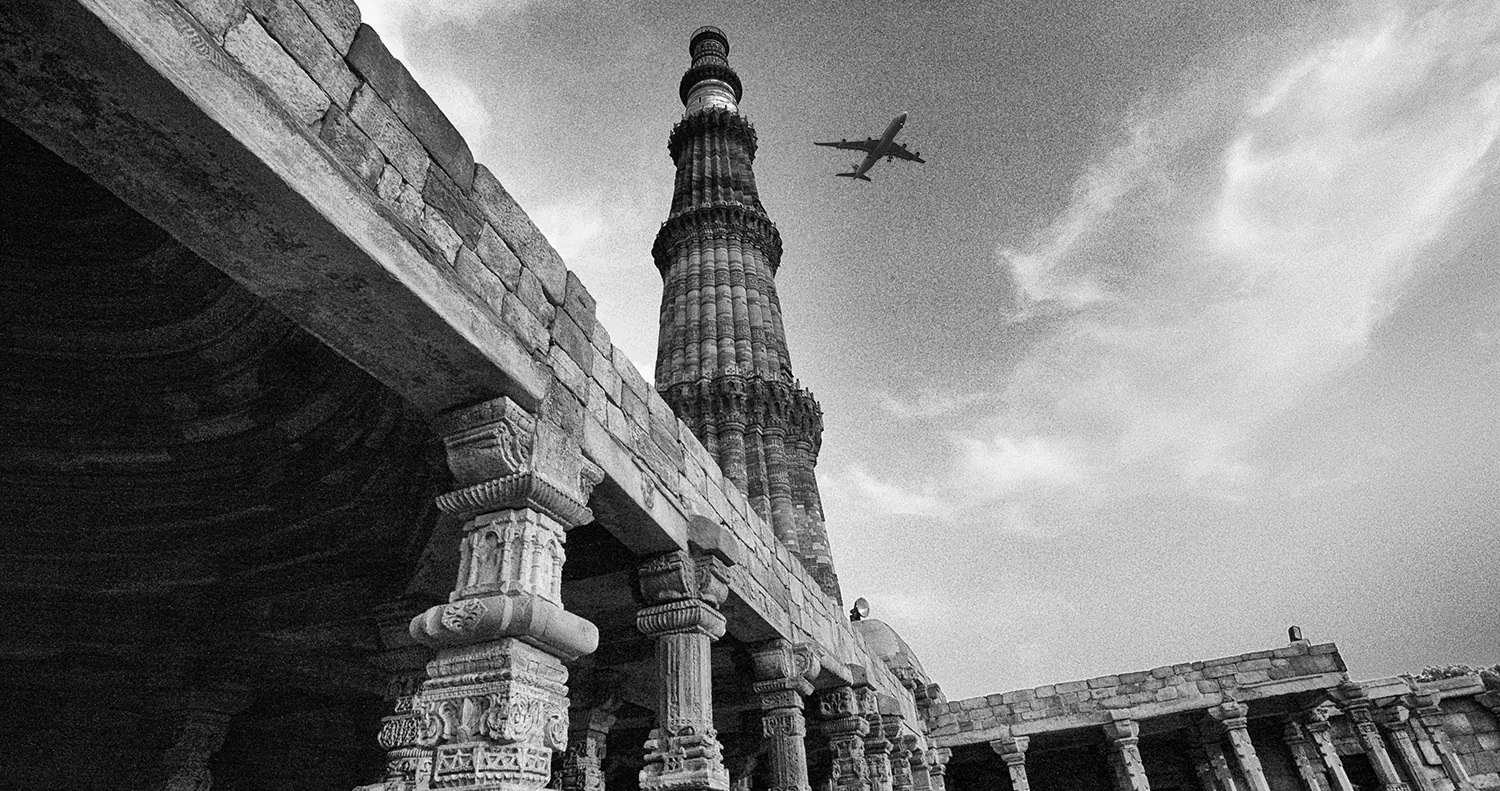
Two things are happening in this one frame. Look at the pillars in the foreground, then up at the tower, and you're seeing two faiths in a single glance — the minaret unmistakably Islamic, austere and inscribed with scripture, while the colonnade holding up the view was lifted almost wholesale from the Hindu and Jain temples that stood here first. Their gods were chiselled away or turned to face the wall, but the lotuses and bells survive on the stone, blooming inside arches built to a different god. The conquerors didn't import their architecture so much as reassemble the city they found.
And then — there's the jet, on its way into the airport you landed at. Eight hundred years of reused stone and a passenger flight, stacked in the same photograph. That's Delhi's whole trick: it never clears away the old to make room for the new, it just keeps piling the present on top and lets you sort it out.
The tower is only half the visit, though. A few steps away stands the Iron Pillar — seven metres of wrought iron that has stood in the open for over 1,600 years and, bafflingly, refuses to rust; metallurgists still travel here to argue about why.
Around it sprawl the remains of Quwwat-ul-Islam, Delhi's earliest mosque, its colonnades stitched from the carved stone of older temples — look closely and a stray lotus or bell turns up hiding inside an Islamic arch. The whole site is layered like that. Delhi's entire history in one courtyard, if you read the walls.
Go early — the complex is open to the sky with little shade, and by midday the sandstone throws the heat back at you. Tickets at the gate (around Rs. 600 — verify, foreign-national rate higher). You can't climb the minaret; access was sealed decades ago after a stampede inside and a few other tragedies from the top. Rules get written because of the worst day, not the regular ones. So come for the carving and the courtyard, not a view from the top.
And if you've worn yourself out, there's shelter across the road at Olive Bar & Kitchen — all whitewashed walls and bougainvillea, a cool change of register after the heat.
Jama Masjid
Shah Jahan's last great act of building, and India's largest mosque — finished in 1656, the same emperor who gave the world the Taj turning his hand from a tomb to a house of prayer. Red sandstone and white marble, three gateways, two minarets, and a courtyard that holds twenty-five thousand people without crowding. It sits on a rise in the thick of Old Delhi, looking down on the bazaar that has roared at its feet for nearly four centuries.
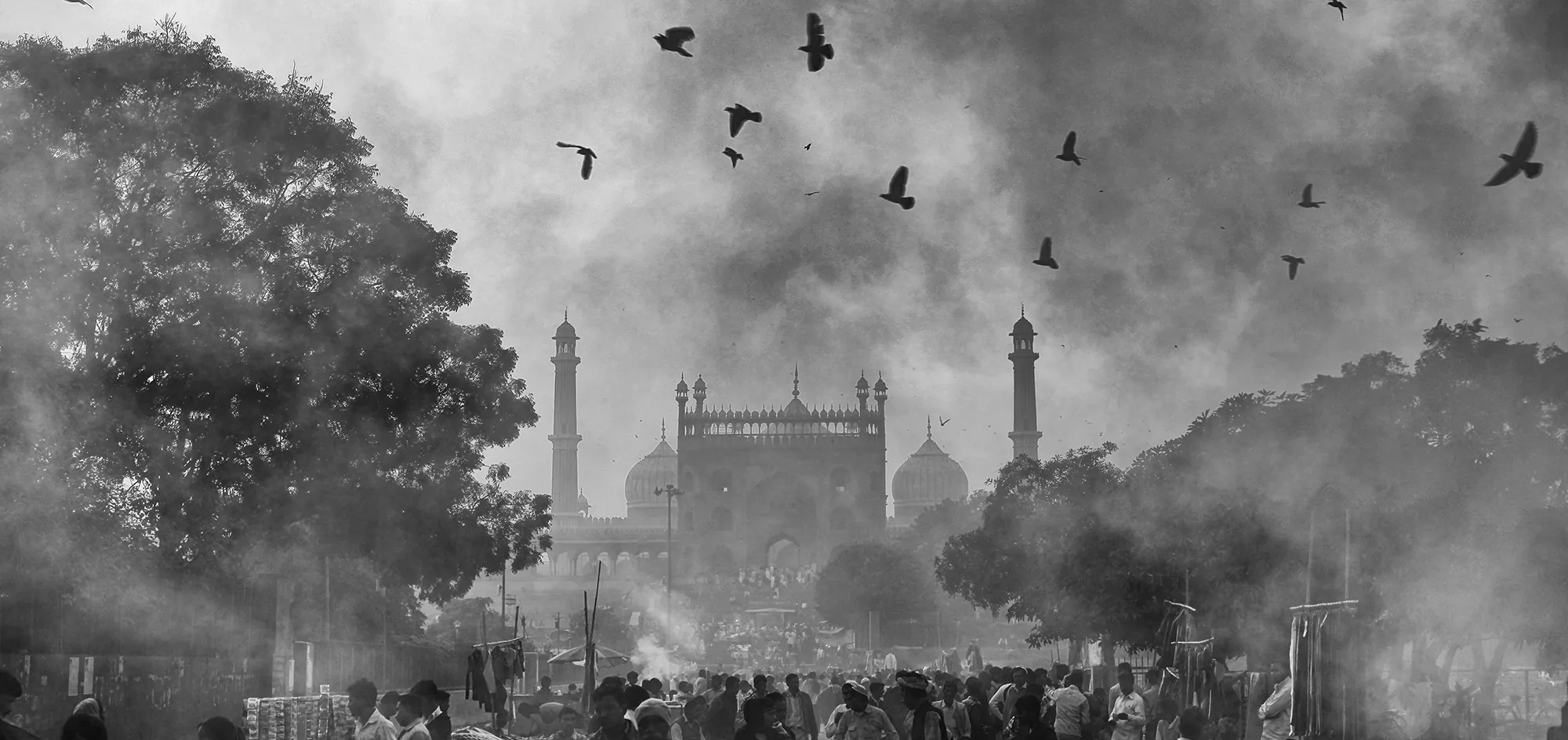
You climb to it. The great flights of stone are part of the experience — and so are the people on them. This is a working mosque, not a relic behind rope; on any given day you'll share the steps with worshippers, families, old men who've sat at the top for years watching the city go by. Come dressed for it (shoulders and knees covered, shoes off at the threshold, robes available to borrow), come outside prayer times if you want room to wander, and come with the understanding that you're a guest in someone's place of worship, not a ticket-holder at an exhibit.
Inside, the courtyard opens up enormous and flat and calm but the better discovery is upward. Pay the small fee to climb the southern minaret and Old Delhi rearranges itself beneath you. The domes you've only seen from below become great smooth shoulders of stone at eye level; the rooftops, the rubble, the chaos all spread out in the gaps between them.
And from the top, the whole thing finally makes sense — the courtyard you stood in reduced to a pale rectangle, the gateway, the bazaar, the city running flat to the horizon in every direction. You came up a tourist; you look down a little awed.
A few honest notes. The minaret climb is narrow, dark, and steep, and at the time of writing women may be required to be accompanied by a male relative to go up — a rule that comes and goes, so ask at the base. Entry to the mosque is free; expect a camera fee, a fee for the minaret, and someone minding your shoes for a few rupees. Fridays and prayer times are for the faithful, not for sightseeing — plan around them.
