
Everything so far has been measured in centuries. This last stretch is barely a hundred years old — which in Delhi still counts as new.
India Gate & the Ceremonial Axis
Delhi's other imperial city — not Mughal but British, laid out by Edwin Lutyens and Herbert Baker when the capital moved here in 1911. Where Old Delhi is dense and organic, this is the opposite: a single grand axis, three kilometres of deliberate sightline, built to be walked.
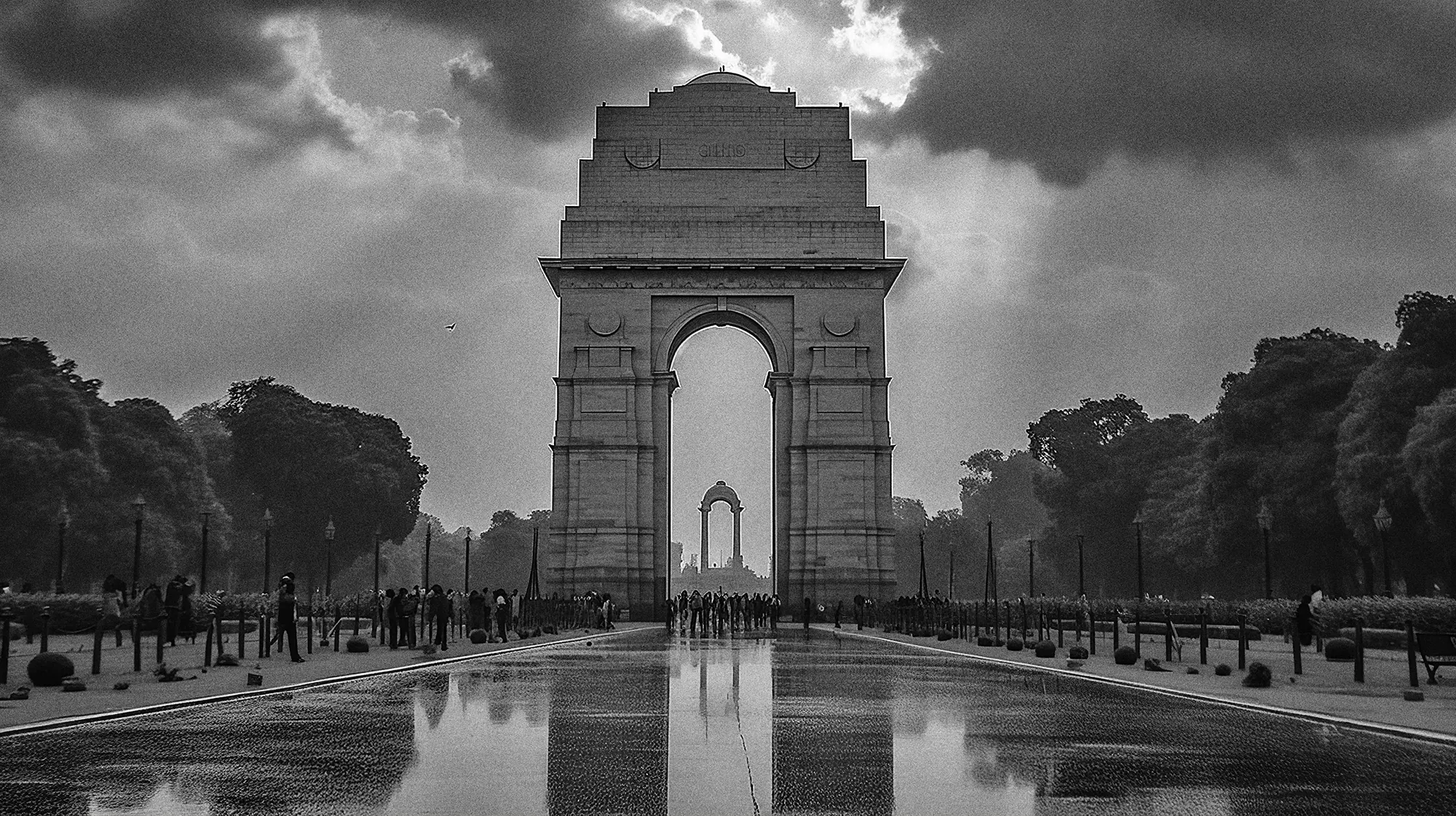
Start at India Gate, the 42-metre sandstone war memorial to the Indian soldiers who died in the First World War and the Third Anglo-Afghan War — their names carved into the stone. From there the eye runs up Kartavya Path (the avenue formerly called Rajpath), its lawns, canals and reflecting pools flanking the slow rise toward the government quarter — the same processional route the Republic Day parade takes each January. At the top, the two long blocks of the Secretariat (North and South) stand guard either side, all domes and colonnades, and behind them rises Rashtrapati Bhavan — once the Viceroy's House, now the President's residence, a 340-room sandstone palace bigger than Versailles.
Walk it in the evening when the heat breaks and the buildings light up. The full axis is the point — the scale, the symmetry, the slow climb from memorial to palace. Free and open; the lawns and pools are a public hangout after dark, especially in the cooler months. Rashtrapati Bhavan's interiors and Mughal Gardens can be visited too, but only on specific days with advance booking (verify current rules — they change).
